The 5 Questions Every Internal Communicator Should Be Able to Answer
Join Cerkl’s free July 9 webinar to learn five practical questions every internal communicator should be able to answer about reach, engagement, impact, and analytics.


Join Cerkl’s free July 9 webinar to learn five practical questions every internal communicator should be able to answer about reach, engagement, impact, and analytics.
Picture the moment after you send the all-staff message about the reorg. You spent two days on it. Legal signed off. The send went clean. Then your VP stops you in the hall and asks, "Did that land?" And the honest answer is that you don't really know. You know it went out. You're hoping it worked.
That gap, between "we sent it" and "we can prove it worked," is where most internal communications programs live. It isn't a gap in effort. It's a gap in measurement. And it shows up the moment someone with a title asks a question you can't answer from the tool you're using.
Most internal communicators are working from Gmail, Outlook, or an intranet that was never built to tell you whether employees engaged with what you sent. So the questions leadership asks, the ones that decide whether comms gets treated as a strategic function or an afterthought, go unanswered. Not because the communicator failed. Because the tool was never designed to answer them.
Here's the good news, and the thing we want you to walk away believing: you do not need to be a data analyst to answer these questions. You don't need a BI tool, a spreadsheet marathon, or a standing meeting with someone in Finance. The five questions below are answerable in minutes, by you, and the experience that answers them is free to start. More on that at the end.
Before you can talk about engagement, you have to be sure the message actually arrived. "I never got that email" is the sentence that quietly undermines every comms program, because you usually can't prove otherwise. Reach is not "I hit send." Reach is delivery you can stand behind: who it was sent to, who it reached, and who opened it.
Audience visibility starts before the send, not after. When you can see delivery and opens down to the individual, "did it go out?" stops being a leap of faith and becomes a number you can say out loud with confidence.
A 60% open rate sounds fine until you ask who the other 40% are. Averages hide stories. That single number can hide that your frontline workers are tuned out while managers are over-saturated, that new hires never engage in their first month, or that one location reads everything and another reads nothing.
The real skill isn't reporting the average, it's comparing the groups: frontline vs. managers, new hires vs. tenured, the Albany office vs. the company as a whole. That's where the insight lives, and it's where the action lives too. When you can see who is engaged, you stop sending the same thing to everyone and hoping, and start communicating to the people who actually need to hear from you.
Want to see this answered live? Rachel and Maddy will walk through it on July 9. Register here →
Most send times are a guess dressed up as a habit. "We always send Tuesday at 9" is an opinion, not a strategy. The right answer is in your audience's behavior: when do they actually open and click, and when does a message just sink to the bottom of the inbox?
Filter to a group, look at when they engage across the week, and the pattern is usually obvious once you can see it. A heatmap of delivery, opens, and clicks over time tells you where to place the message so it lands when people are actually reading, instead of when it was convenient to hit send.
Every subscription, preference, and click is a small vote. Your employees are telling you what they care about all the time; most tools just don't tally the ballots. When you can see which categories and topics employees return to, you stop guessing at the editorial calendar and start building it around what people actually value.
This is also where evergreen content earns its keep. A piece that keeps getting opened and clicked weeks after it went out is doing long-term work, even though the day-of numbers looked ordinary. Measuring resonance, not just the first 24 hours, changes what you choose to make more of.
Data isn't the destination. Better communication is. The point of the first four questions is to tell you where to go next: which categories are underperforming, which audiences are overcommunicated to, which communicators on your team are getting standout results worth copying, and which opportunities you haven't touched yet.
This is the move from message sender to strategic communication advisor. When you can benchmark, spot what's working, and bring a recommendation instead of a recap, you stop defending your function with effort and start leading it with evidence.
Leadership's expectations of internal comms have moved. "We sent the update" used to be enough. Now the follow-up question is automatic, and it's some version of "and did it land?" Teams that can answer get a seat at the table. Teams that can't keep defending their value with effort instead of evidence.
The reason these five questions are answerable now, and not aspirational, is that the analytics built for internal communicators have caught up. Cerkl rebuilt the analytics experience inside Broadcast, and it's called Insights. Here's the part that matters most: it was designed for communicators, not data analysts. You see your data as a picture instead of a spreadsheet. You move from a leadership-level summary down to a single subscriber's history without losing your place. You hand a clean view to a stakeholder without exporting anything or building a deck at 9 PM.
And it's free. Insights is available on Foundations, Cerkl's free tier, so you can start answering these five questions about your own sends without a budget conversation. That's the whole point: leadership-worthy reporting, no analytics skills required, no cost to begin. Yes, you can do this.
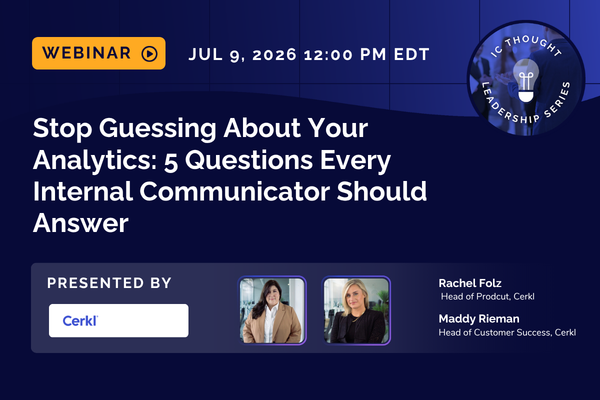
Rachel Folz, Head of Product, Cerkl. Rachel turns big ideas into practical tools that simplify how organizations connect with their people. She led the team behind the new Insights experience and brings the product and measurement point of view: what these five questions look like when you can actually answer them in the product. Rachel is also Co-Lead of Women in Product Cincinnati.
Maddy Rieman, Head of Customer Success, Cerkl. Maddy brings the customer-success lens: what communicators across real accounts struggle to answer when she asks how they measure their comms, and where the gap between "we send a lot" and "we can prove impact" shows up.
"Stop Guessing About Your Analytics" is a free, 60-minute webinar on Thursday, July 9, 2026, at 12:00 PM EDT. Rachel and Maddy will walk through all five questions, show the new Insights experience live, and run a few quick polls so you can diagnose where your own program stands today, from where you're tuning in to the one thing you'd most want to fix about your communications.
You'll leave able to do something different Monday morning: ask the five questions, find the answers in minutes, and walk into the room with proof instead of a hopeful shrug. And you'll know you can do it yourself, for free.

That's why we built Foundations. Purpose-built for internal email with all the features you wish you had - drag-and-drop email builder, analytics, employee segmentation and much more. All for free (forever). No credit card, no contracts, no setup fees.