Run a Wellbeing Series Without Five Different All Staff Emails
Learn how to run a coordinated employee wellbeing campaign using segmentation, scheduling, and consistent messaging—without relying on multiple all-staff emails or messy spreadsheets.


Learn how to run a coordinated employee wellbeing campaign using segmentation, scheduling, and consistent messaging—without relying on multiple all-staff emails or messy spreadsheets.
Wellbeing campaigns often become messy for reasons that have very little to do with the quality of the message itself. During moments like National Public Health Week, several teams usually have a legitimate reason to communicate at once, so HR shares available resources, benefits promotes a program, managers are asked to reinforce the message, and internal comms tries to hold it all together. The result is predictable. Employees receive multiple messages that cover related ground without feeling connected, while the team behind the campaign mistakes activity for coordination.
That pattern creates more than inbox fatigue. It fragments the employee experience because people are forced to piece together the campaign on their own, often from a handful of overlapping emails that arrive too close together, use slightly different language, and point to different actions. A strong employee wellbeing campaign should not require employees to decode what matters, which audience a message is meant for, or whether one email has replaced the last. It should feel organized from the start because the planning behind it was organized first.
Most disconnected campaigns are built inside disconnected workflows. Copy is drafted in one place, audience decisions are tracked somewhere else, timing lives in a spreadsheet, and approvals happen in scattered messages that are easy to lose and hard to audit later. Even when the people involved are capable and well-intentioned, the system surrounding them creates inconsistency because no one is working from a single operational view of the campaign.
That is where small issues become bigger ones. Messaging shifts because each stakeholder frames the campaign through their own priorities, so one send emphasizes mental health support, another pivots to financial wellbeing resources, and a third repeats a general reminder that adds little value for the employee receiving it. Timing becomes uneven because one message is ready early, another is delayed in review, and a third is rushed out after someone realizes a key date is approaching. Audience decisions become equally inconsistent when one send goes to everyone, another goes to a limited group, and nobody can easily see how those choices relate to the broader campaign plan.
When that happens, the campaign does not feel intentional, even when the content is useful. Employees experience a collection of messages rather than a guided sequence, and communicators spend more time managing preventable coordination problems than improving the actual communication strategy.
A better approach starts when teams stop treating each message as a standalone send and begin treating the full effort as multi-touch employee communication with a clear sequence, a defined audience strategy, and a practical view of how employees actually absorb information over time. In a coordinated model, each touchpoint has a job to do, which means the first message establishes the theme, later messages add detail or relevance, and follow-ups reinforce action without repeating what employees have already seen.
That structure matters because most employees do not take action the first time they encounter a wellbeing message, especially when they are balancing day-to-day work, competing priorities, and a crowded digital environment. Repetition alone does not solve that problem. Sequencing does. When a campaign is designed so that each message builds on the last, employees are more likely to understand why the topic matters, what they should do next, and where to go when they are ready to engage.
For the communications team, this model also creates operational clarity. Stakeholders can see how their content contributes to the larger campaign, which reduces the impulse to send one more all-staff email just to ensure their message gets visibility. That shift sounds simple, but it changes the work in a meaningful way because it replaces reactive sending with planned communication.
Segmentation is where most employee wellbeing campaigns either become more effective or collapse back into broad, repetitive sending. Too many teams still rely on distribution lists as though access and relevance were the same thing, even though they solve very different problems. A distribution list tells you who can receive a message. It tells you nothing about whether that message is useful, timely, or appropriately framed for that audience.
In practice, wellbeing messaging is never equally relevant to every employee at the same moment or in the same format. Frontline employees may have limited time to engage with long email content during a shift. Remote employees may need different guidance, resources, or channel placement than employees who work onsite. Managers may need short, practical context they can reinforce with their teams, while individual contributors may need direct links to benefits, support tools, or events. When those differences are ignored, communicators usually compensate with volume, because sending to everyone feels safer than making audience decisions that require more intention.
That is exactly why internal communications segmentation matters. It reduces the need for broad all-staff communication by giving teams a more practical way to match the message to the audience. In most cases, communicators do not need a highly complex model to improve campaign performance. Role, location, and work environment are often enough to make the message more useful without creating an unmanageable production burden. Once those segments are in place, the content can stay strategically consistent while the framing becomes more specific, which means fewer unnecessary sends and more relevant communication across the campaign.
Campaigns become chaotic when timing is managed as a series of decisions made under pressure rather than as part of a plan established before launch. That is why so many wellbeing initiatives feel uneven. One message goes out because a stakeholder wants visibility right away, another is squeezed in around a calendar event, and a third appears late because someone realizes the campaign has gone quiet. None of that usually happens because teams are careless. It happens because there was no shared schedule strong enough to hold the campaign together.
A better system starts with a communication calendar that reflects the full sequence, not just isolated sends. When a team anchors a wellbeing campaign to moments such as World Health Day, an awareness week, or a benefits enrollment touchpoint, it becomes easier to decide what should happen first, what should follow, and what should be reserved for a more targeted audience. Pre-scheduling the campaign also creates discipline because it forces stakeholders to align on message order, audience logic, and channel use before execution begins.
That kind of structure does not add work. It removes work that should never have been manual in the first place. Teams spend less time reacting, chasing approvals, and resolving accidental overlap, while employees receive communication that feels deliberate rather than improvised. Cerkl Broadcast with Omni AI supports that process by helping teams organize, personalize, and schedule campaign communication in a way that reduces manual coordination across channels.
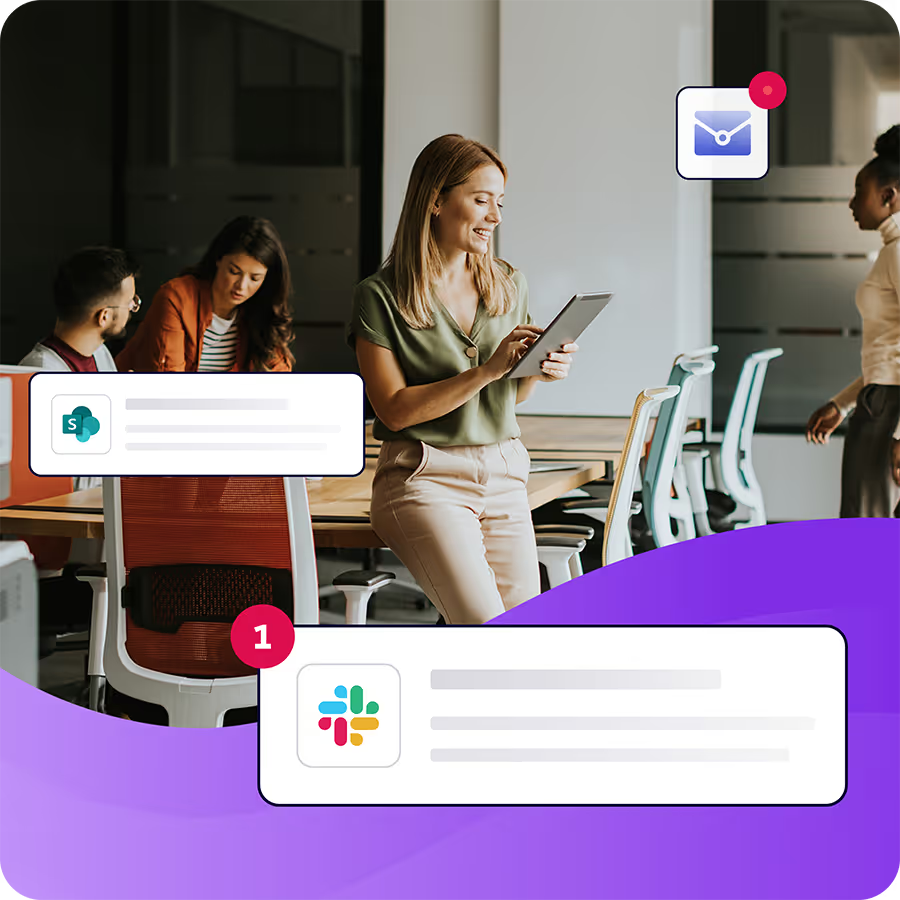
Broadcast Omni AI helps large organizations deliver personalized communication across email, mobile, Teams, intranet, and more. Content orchestration at scale.
Learn more about Omni AIOne of the fastest ways to weaken a campaign is to rewrite every touchpoint as though it belongs to a different initiative. That habit usually comes from speed, stakeholder pressure, or a mistaken belief that freshness requires reinvention, but it creates more problems than it solves because the campaign starts to sound inconsistent even when the topic is consistent.
Stronger campaigns begin with a central message architecture. The team defines the theme, the supporting points, the tone, and the action they want employees to take, then adapts that foundation across the campaign instead of recreating it every time. An email may introduce the campaign and explain why the topic matters now. A follow-up message may highlight one practical resource or event. A manager-facing version may translate the same campaign into talking points that help supervisors reinforce the message in team settings. The format changes. The intent should not.
This matters because consistency builds recognition, and recognition makes campaigns easier to follow. Employees should not have to relearn the message every time they encounter it in a different place. From the team’s perspective, this approach also reduces production drag because writers and reviewers are refining a shared message instead of debating new copy from scratch with each send.
Spreadsheets remain common in campaign planning because they give teams a quick place to organize sends, audiences, dates, and owners, but they do not solve the harder problem, which is executing a campaign without losing control of the moving parts. Once a spreadsheet becomes the operational center of a campaign, communicators still have to move between systems to build messages, manage approvals, update audience selections, and schedule delivery, which increases the chance that timing, targeting, or content will drift out of sync.
That gap between planning and execution is where avoidable errors tend to happen. A date changes in one place but not another. An audience update is logged but not applied. A stakeholder assumes a message has already been scheduled because it appears on the spreadsheet, even though no one has actually set it up. These are not edge cases. They are normal outcomes when the campaign lives in a static planning document but executes across several disconnected tools.
Centralized execution gives teams a more reliable model because the campaign can be built, scheduled, targeted, and adjusted in the same environment. That creates visibility across the full workflow and makes it easier to prevent duplicate sends, catch conflicts early, and move faster when something needs to change. Cerkl Broadcast brings those elements together so that the team can spend less time managing the mechanics of coordination and more time improving campaign quality.
A weeklong employee wellbeing campaign does not need a large volume of communication to feel visible and useful. It needs a clear progression that reflects how employees engage, what each audience needs, and where reinforcement will actually help. Consider a simple campaign built around a wellbeing awareness week. On Monday, the organization sends a broad message that introduces the campaign theme and explains why the topic matters now, but even that opening communication is segmented by location or work environment so that the examples, links, and framing feel appropriate to the audience receiving it.
By midweek, the campaign becomes more specific. Remote employees may receive content focused on burnout prevention, workday boundaries, or virtual support resources, while onsite employees receive content tied to physical workspace support, local programming, or benefits they can access more easily in person. Because the messages are targeted, neither group receives information that feels generic or poorly matched to their day-to-day experience.
Later in the week, managers receive a short communication that helps them reinforce the campaign without forcing them to build talking points from scratch. That touchpoint is important because manager reinforcement often determines whether a campaign stays abstract or becomes visible within teams. Then, toward the end of the week, the campaign closes with a reminder or action-focused follow-up aimed at employees who have not yet engaged, rather than another broad send to the entire organization. The message is narrower, clearer, and easier to act on because it has a defined purpose within the sequence.
What makes this approach work is not complexity for its own sake. It is the fact that each message has a reason to exist and a specific role within the broader employee wellbeing campaign. Employees receive communication that develops over time instead of repeating itself, while the communications team works from a plan that was structured before the first message went out.
Wellbeing campaigns perform better when coordination improves, not when send volume increases. That distinction matters because many teams still respond to weak engagement by adding more messages, even though the real issue is usually fragmented planning, inconsistent targeting, or a sequence that never made strategic sense in the first place.
A stronger approach starts by defining the campaign before execution begins. Identify the audience groups that matter most. Build a sequence that reflects how the message should unfold. Create a central message structure that can be adapted without losing consistency. Then use a system that keeps targeting, scheduling, and content connected so the campaign does not fall apart during execution.
Cerkl Broadcast with Omni AI supports that model by helping teams run multi-touch employee communication with less manual coordination and more control over timing, relevance, and delivery. That is the practical shift communicators should be aiming for. Fewer broad sends, better audience logic, tighter sequencing, and campaigns that respect employee attention because they were built with more discipline from the start.
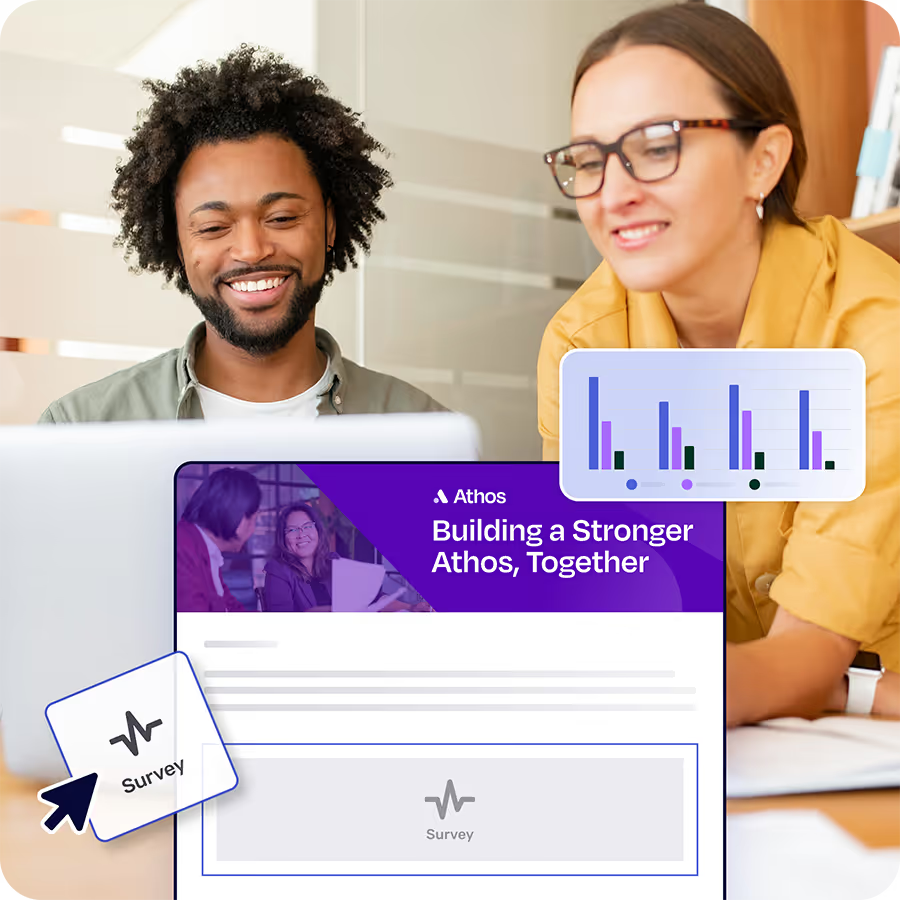
That's why we built Foundations. Purpose-built for internal email with all the features you wish you had - drag-and-drop email builder, analytics, employee segmentation and much more. All for free (forever). No credit card, no contracts, no setup fees.
Learn more about FoundationsWhat is an employee wellbeing campaign?
An employee wellbeing campaign is a coordinated series of communications designed to promote physical, mental, and emotional health resources to employees. Instead of one-off emails, it uses multiple touchpoints to build awareness, encourage participation, and reinforce key messages over time.
How does internal communications segmentation improve wellbeing campaigns?
Internal communications segmentation improves relevance by tailoring messages to specific employee groups. Instead of sending broad all-staff emails, segmentation ensures employees receive content that matches their role, location, and needs, which increases engagement and reduces message fatigue.
What is multi-touch employee communication?
Multi-touch employee communication is a strategy where messages are delivered in a planned sequence across time and channels. Each message builds on the previous one, helping employees understand, engage with, and act on the information without feeling overwhelmed.
Why should teams avoid multiple all-staff emails?
Multiple all-staff emails create noise, reduce trust, and lower engagement. Employees begin to ignore messages when they feel repetitive or irrelevant. A segmented, multi-touch approach delivers fewer but more meaningful communications.
How can you plan a wellbeing campaign without spreadsheets?
You can replace spreadsheets by using a centralized communication platform that combines audience targeting, scheduling, and content management. Tools like Cerkl Broadcast allow teams to plan and execute campaigns in one place, reducing manual coordination and errors.