<script type="application/ld+json">
{ "@context": "https://schema.org", "@type": "FAQPage", "mainEntity": [ { "@type": "Question", "name": "What is benefits communication?", "acceptedAnswer": { "@type": "Answer", "text": "Benefits communication is the set of messages, campaigns, and content a company uses to inform employees about the benefits they are eligible for, including healthcare, retirement, parental leave, financial wellness, and other rewards programs. It is distinct from benefits administration, which handles enrollment and claims. Effective benefits communication ensures employees understand what is available, when it applies to them, and how to act on it." } }, { "@type": "Question", "name": "Why does benefits communication fail?", "acceptedAnswer": { "@type": "Answer", "text": "Benefits communication tends to fail for three reasons. First, ownership is unclear: HR teams hold the content and internal-comms teams hold the channels, and neither group has the bandwidth to coordinate year-round. Second, most communication is timed around annual enrollment rather than the moments employees need the information. Third, a large share of total benefits comms comes from third-party vendors, which means the company funds the benefit but does not control the narrative. The result is a gap between what is offered and what employees know about, understand, or use." } }, { "@type": "Question", "name": "How do you measure benefits communication effectiveness?", "acceptedAnswer": { "@type": "Answer", "text": "Open rates and click-throughs are starting points but they are not enough. A more complete measurement structure asks five questions: did employees see the message (visibility), could they reach the underlying content (accessibility), did they understand what was offered (literacy), did they act on it (usage), and what was the felt quality of the interaction (experience). Each dimension can be captured through analytics, pulse surveys, focus groups, or anecdotal feedback. The goal is a benchmark a team can return to over time, not a perfect dashboard." } }, { "@type": "Question", "name": "How often should you communicate about benefits?", "acceptedAnswer": { "@type": "Answer", "text": "Year-round, in three layers. An evergreen content hub for in-the-moment answers. A steady drum beat of smaller communications across the year, since most messages need to be seen multiple times before they register. And occasional high-impact campaigns tied to events outside the enrollment calendar. The pattern of 'silence for 350 days followed by a cacophony at enrollment' trains employees to filter the inbox harder, which makes everything else land less." } } ]
}
</script>
Companies spend $28,250 per employee on benefits, and most employees never use what they have. The hidden cost is the comms gap, but there’s a fix.
Written By:
Cerkl Research Team
Published:
May 21, 2026
Using Outlook or Gmail for your internal communication?
Foundations is free (forever) - purpose built for internal comms and includes everything you need to level up your game (email builder, analytics, pulse surveys and much more).
US employers spend, on average, $28,250 per employee per year on benefits, according to the Bureau of Labor Statistics. UK employers spend roughly £10,000 per person on the same category. That figure is the visible cost, the one leadership signs off on. It shows up cleanly in the budget. What does not show up cleanly is whether the people receiving those benefits know they exist, understand them, or use them when they need them.
That gap is a hidden cost. It does not have a line item, but it has consequences. When a 12,000-employee company offers a travel-loan benefit and three employees use it, the company is paying for something nobody is getting value from. The benefit is relevant. Nobody told the audience clearly enough for it to register. Multiply that pattern across an enrollment guide, a wellness program, a retirement plan, and a parental-leave policy, and the gap between what is paid for and what is understood becomes its own cost center. This post names the hidden cost, explains why it persists, and offers a working framework for closing it. The diagnosis and the fixes draw on a recent hour-long conversation between Matt Frost, founder of IC Partners and a 25-year practitioner in benefits communication, and Tarek Kamil, founder and CEO of Cerkl.
What the hidden cost looks like
The hidden cost shows up in three places. The first is wasted spend. A benefit nobody knows about is, financially, a benefit that does not exist. The 12,000-employee travel-loan example is the cleanest version, but the pattern is everywhere. Employees write to their HR teams asking the company to offer mobile phone insurance, when the company already offers it. Mental health benefits go un-enrolled, parental support programs go unused, financial-counseling lines stay quiet through a year when employees were spending more on debt than ever before. The plans are there. The communication failed.
The second is eroded trust. When benefits communication reads like it was written by a lawyer for another lawyer, employees do not delete it anymore. They share it. A government-issued pension communication, posted online with a confused-and-frustrated reaction, becomes a small piece of the public record on what it feels like to be informed about your money. The damage compounds. The next message, the one that matters, the urgent one about an enrollment change or a deadline, arrives in an inbox where the previous five have trained the audience to expect noise. Trust erodes one cold message at a time, and rebuilding it costs more than getting the messaging right the first time.
The third is vendor narrative control. When the company funds the benefit but the healthcare carrier or the retirement provider sends most of the communications, the vendor's logo is on the inbox, the vendor's tone shapes the experience, and the vendor's plan structure organizes the content. The company becomes a footnote on its own benefit. As Matt Frost put it: "If your vendors are louder than you, they're getting the credit. They're controlling the narrative." The hidden cost there is reputational. The company pays for the benefit, the employee remembers the vendor.
In financial terms leadership can hold, every dollar spent on a benefit nobody understands is a dollar that bought nothing. Leadership already approved the visible cost. The hidden cost is recoverable.
Why it happens: from compliance to connection
Most internal-comms teams know benefits communication could be better. What stops them is a maturity ladder leadership rarely names.
The ladder has four rungs. Compliance is at the bottom: communication exists because regulation requires it. Boxes are ticked and copy is written by the cold hand of a lawyer. Clarity is one rung up: the team takes time to explain things in ways that help people understand what, when, and why it matters. Relevance is higher still: the team thinks about the message from the audience's perspective and personalizes content to reflect different lives, life stages, and known needs. Connection is at the top: the team uses the comms moment to build trust and signal care. Transparency is the means; language is the proof.
Most organizations are stuck somewhere between clarity and relevance. The block is time and ownership, not capability. HR and total rewards teams hold the content but lack the bandwidth and the practice for coordinating year-round campaigns. Internal comms generalists hold the channels, but benefits sits behind quarterly results, leadership announcements, and culture initiatives in their queue. Both groups know what better would look like. Neither group has the room to build it.
The asymmetry becomes visible against marketing. No marketing team would launch a campaign without measuring whether the audience saw it, understood it, or acted on it. Yet people-related communication, which represents roughly 70 percent of most company budgets, gets a different standard. Tarek's question to Matt during their conversation framed the gap directly: "How did we get to a state where something so important is reduced to checking a box?"
The ladder asks for a different posture toward the audience: fighting for their attention rather than informing them.
Internal emails shouldn't be a black box.
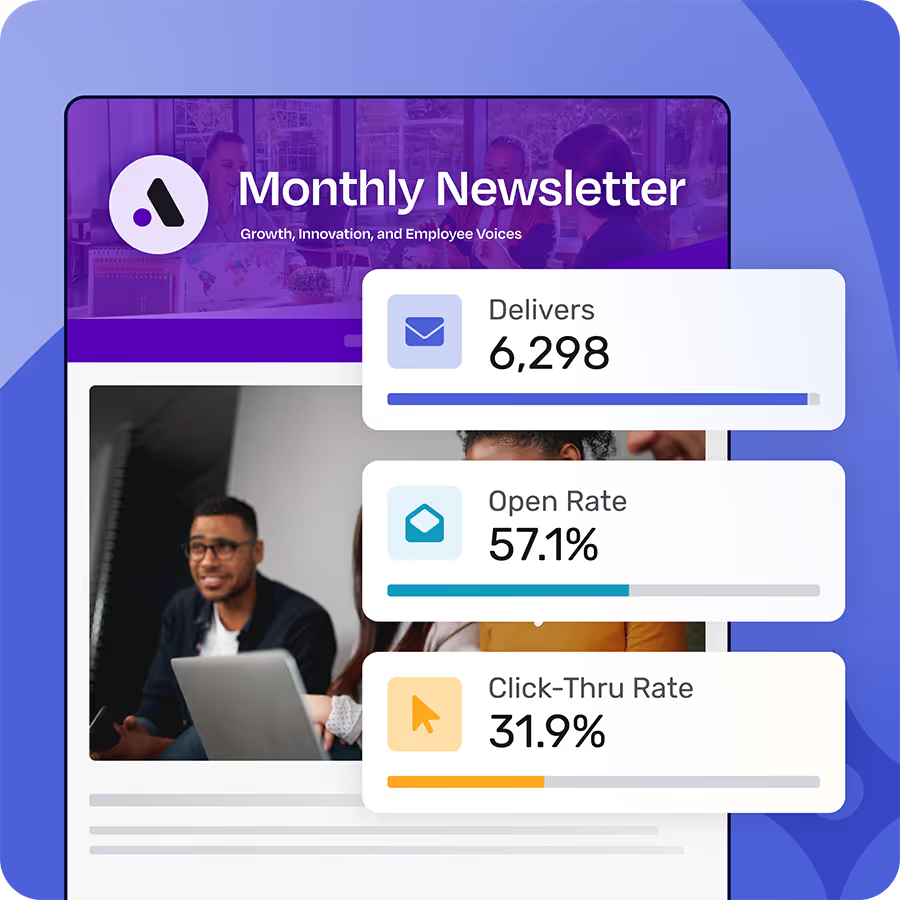
Foundations shows who opened, clicked, and engaged with your employee communications so you know what’s actually working. All for free - forever.
Matt drew the line cleanly: "No one wakes up in the morning and thinks, 'I'm going to spend two and a half hours of my life cover to cover reading that benefits communication.'" If the audience is not captive, every benefits message has to earn the open. Every other inbox, app, and notification is competing for the same thirty seconds. Four moves decide whether the message wins.
Make it interesting. A pensions campaign for a UK retailer built its messaging around a character named Nana, an agony-aunt grandma figure who was provocative, glamorous, and unapologetically herself. She replaced the white-linen-couple-on-a-beach financial-wellness cliché that nobody relates to. The character was not novelty for its own sake. It was that the message stopped being skippable. An interesting opening earns a few seconds of attention, and a few seconds is the only window the audience is offering.
Make it meaningful. Connect the message to the moment the audience is in. "If you are up at one in the morning searching the internet about your child's symptoms, we can help with that." That sentence does work "we offer 24/7 telehealth as part of your benefits plan" cannot do. Specificity about the moment beats a description of the benefit every time, because the audience finds the moment first and the benefit second.
Make it emotive. Real stories of people whose lives changed because of a benefit they used. One campaign Matt cited centered on an employee who said, "This lady had cancer living right on my face, and I didn't know about it." A screening through a benefits-covered visit caught it. The plan had been there for years. The story was the unlock. Emotion is what makes the audience reach for the benefit when the moment arrives, not when the email arrives.
Make it findable. Most companies' benefits content lives in a half-dozen places. An intranet page that is hard to find. PDFs in a shared drive. Vendor portals that require separate logins. Email archives nobody searches. A single point of entry, organized for the user by life moment and by need, with search, filters, and tags, is the difference between a benefit that gets used in the moment and one that stays buried until somebody asks HR a direct question.
The four moves stack. Interesting opens the door. Meaningful holds attention long enough for the message to land. Emotive earns the trust that makes the audience act. Findable means the action is one click away when the moment arrives.
Control the message all year
Most benefits-communication cycles look the same. Three hundred and fifty days of silence, followed by two weeks of cacophony around annual enrollment. Neither end of the pattern serves anyone. Silence trains the audience to assume nothing important happens here. Cacophony trains them to filter the inbox harder.
A different shape works better. Three layers, running in parallel.
The evergreen layer is the always-on foundation. It answers questions the audience asks at the moment they ask them. A single hub, organized around life moments rather than plan administrators, where the content is current and the path is short. Nobody has to dig for it because it does not ask them to.
The drum beat is the steady cadence of small communications throughout the year. Most messages need to be seen multiple times before they register, and a single email at enrollment is not enough exposure for anything that matters. Stories that surface benefits in the normal flow of company communication, like a leader sharing how they used a benefit, a quarterly note about a benefit category coming into season, or a short reminder about a deadline three months out, keep the audience aware without overwhelming them.
The high-impact campaigns sit on top: the Nana-style guerrilla moments, the emotional story drops, the concentrated bursts that exist for reasons other than the enrollment calendar. These land more easily when the evergreen and drum-beat layers are doing their work, because the audience is already paying low-grade attention and a campaign can grab the rest of it.
One structural audience most benefits communication misses: dependents. According to the National Bureau of Economic Research, 84 million employees in the US are covered by benefits, alongside 74 million dependents. Nearly half of the people receiving benefits and making plan decisions are family members the company has never communicated with directly. They do not see the breakroom flyer, do not get the all-staff email, and do not log into the intranet. Reaching them through home email capture, family-friendly content, or intentional inclusion of dependents in messaging closes the largest under-served audience most benefits-comms teams have.
How to know it is working: the VALUE framework
Open rates and click-throughs are not enough to defend a benefits-communication investment in front of leadership. They tell you something opened an email. They do not tell you whether the audience understood what was inside or used the underlying benefit. Defending a budget requires a more complete picture.
Matt's framework for that picture is a five-part structure called VALUE.
Visibility: asks whether employees saw the message at all.
Accessibility: asks whether the underlying content was easy to reach when they wanted it.
Literacy: asks whether they understood what was offered.
Usage: asks whether they acted on it.
Experience: asks how the interaction felt, whether supported and respected or rushed and confused.
Teams capture each dimension through analytics, pulse surveys, focus groups, and anecdotal feedback. The goal is not a perfect dashboard. It is a benchmark a team can return to, a way of saying, "this is what was true last year, and this is what is true now." Cerkl Broadcast's email analytics and audience-segment reporting surface visibility, accessibility, and usage data without manual reporting work, giving a comms team a defensible baseline to start from.
The framework matters structurally. Matt's line on it: "If you can't measure it, you can't defend it. You can't ask for more budget. You can't dedicate resources to it. You can't bring in outside help." Measurement is the budget-defense tool. It lets a comms team walk into a budget conversation and connect the work to outcomes leadership already cares about.
Matt Frost and Tarek Kamil walked through the diagnosis and the fixes in an hour-long conversation. Watch the full session →
What to take from this
The visible cost of benefits is on the books. Leadership signed off on it. The line item is in the budget. The dollars are spent. The hidden cost is in the gap between what is paid for and what employees use. As the speaker note in Matt's deck framed it, everything spent on benefits that isn't understood is a dollar that bought you nothing, and the cheapest ROI improvement most companies can make is communicating what they already have.
That work is a posture, not a campaign. It looks like writing for the audience instead of the lawyer, building an evergreen hub before launching the next big push, replacing one annual cacophony with twelve months of small drum beats, and measuring the work in dimensions leadership recognizes as outcomes. None of it requires a bigger budget. Most of it requires a different email system, one that supports segmentation, repeatable campaigns, and measurement as native features instead of side projects.
The data is already on the books. The work is making sure it lands.
If you're frustrated with Outlook or Gmail for your employee emails, we understand.
That's why we built Foundations. Purpose-built for internal email with all the features you wish you had - drag-and-drop email builder, analytics, employee segmentation and much more. All for free (forever). No credit card, no contracts, no setup fees.
Benefits communication is the set of messages, campaigns, and content a company uses to inform employees about the benefits they are eligible for, including healthcare, retirement, parental leave, financial wellness, and other rewards programs. It is distinct from benefits administration, which handles enrollment and claims. Effective benefits communication ensures employees understand what is available, when it applies to them, and how to act on it.
Why does benefits communication fail?
Benefits communication tends to fail for three reasons. First, ownership is unclear: HR teams hold the content and internal-comms teams hold the channels, and neither group has the bandwidth to coordinate year-round. Second, most communication is timed around annual enrollment rather than the moments employees need the information. Third, a large share of total benefits comms comes from third-party vendors, which means the company funds the benefit but does not control the narrative. The result is a gap between what is offered and what employees know about, understand, or use.
How do you measure benefits communication effectiveness?
Open rates and click-throughs are starting points but they are not enough. A more complete measurement structure asks five questions: did employees see the message (visibility), could they reach the underlying content (accessibility), did they understand what was offered (literacy), did they act on it (usage), and what was the felt quality of the interaction (experience). Each dimension can be captured through analytics, pulse surveys, focus groups, or anecdotal feedback. The goal is a benchmark a team can return to over time, not a perfect dashboard.
How often should you communicate about benefits?
Year-round, in three layers. An evergreen content hub for in-the-moment answers. A steady drum beat of smaller communications across the year, since most messages need to be seen multiple times before they register. And occasional high-impact campaigns tied to events outside the enrollment calendar. The pattern of "silence for 350 days followed by a cacophony at enrollment" trains employees to filter the inbox harder, which makes everything else land less.
Did you enjoy this content? Please share it with your internal comms friends and colleagues. Just click on any of the links below.