<script type="application/ld+json">
{ "@context": "https://schema.org", "@type": "FAQPage", "mainEntity": [ { "@type": "Question", "name": "What should a 2027 internal communications plan include?", "acceptedAnswer": { "@type": "Answer", "text": "A 2027 internal communications plan should start with a read baseline from 2026, then set goals per audience and per priority message, choose channels by where each group reads, plan a calendar around priority moments, and tie any budget ask to closing the specific gaps the baseline found." } }, { "@type": "Question", "name": "How do you set an internal comms measurement baseline?", "acceptedAnswer": { "@type": "Answer", "text": "Pick five to ten of 2026's priority messages. For each, record which groups it reached and who read it, using opens and clicks as signals and acknowledgments as confirmation. Mark the gaps by group, such as location or shift, and note what each gap cost the business." } }, { "@type": "Question", "name": "How do you justify the internal comms budget for 2027?", "acceptedAnswer": { "@type": "Answer", "text": "Use the baseline. Show leadership which 2026 gaps cost the business, such as missed deadlines or repeat sends, and tie each part of the ask to closing a specific gap. Leadership funds visible problems more readily than general requests for more investment." } }, { "@type": "Question", "name": "Are open rates a reliable way to measure internal email?", "acceptedAnswer": { "@type": "Answer", "text": "Not on their own. Apple Mail Privacy Protection can load images when a message arrives, before anyone reads it, and security tools in many Microsoft 365 workplaces scan links before delivery. Treat opens and clicks as signals per group, and use acknowledgments to confirm reads on must-read messages." } }, { "@type": "Question", "name": "What if I don't have 2026 read data?", "acceptedAnswer": { "@type": "Answer", "text": "Start capturing it now so a baseline exists before your plan is reviewed. Cerkl Broadcast Foundations is free forever, with 5,000 email sends a month and 3 communicator seats. Insights shows opens and clicks per send and per employee from the first blast, and acknowledgments confirm reads on critical messages." } } ]
}
</script>
Internal Communications Plan 2027: Start With What Was Read
Internal Communications Plan 2027: Start With What Was Read
Build your internal communications plan for 2027 on evidence. Find out what employees read in 2026, then set goals. Start free forever with Foundations.
Written By:
Cerkl Research Team
Published:
November 19, 2026
Using Outlook or Gmail for your internal communication?
Foundations is free (forever) - purpose built for internal comms and includes everything you need to level up your game (email builder, analytics, pulse surveys and much more).
To build an internal communications plan for 2027, start with a read baseline and set goals after it. List 2026's priority messages and check which groups each one reached and read. Then set 2027 goals and budget asks against the gaps you find.
Most plans skip that first step, so this post covers it in detail. If you want the whole process from objectives to evaluation, our step-by-step guide to writing an internal communication plan walks through it, and everything below slots into the research stage of that guide.
Why should your 2027 internal communications plan start with what was read?
Because leadership approves plans on evidence, and a send log only proves you pressed the button. A 2027 plan built on what employees read in 2026 answers leadership's first question before anyone asks it.
Picture the planning meeting. You present next year's goals, say better reach to the frontline and a stronger manager channel, and someone senior asks how this year went. If your answer is a list of what you sent and an average open rate, the goals look like guesses, because they are. The room can't tell whether "improve reach to the frontline" fixes a real gap or polishes a channel that already works.
You're in good company if your planning has run this way. In Gallagher's 2023/24 State of the Sector survey of more than 2,300 communicators, only 42% had an overarching strategic plan for the year at all. Plans that do exist usually open with ambitions. For 2027, put the record of what happened first.
You can build that record without a data team. Give it a few hours with your 2026 send history and a short list of the messages that mattered, and write down who read each one, group by group. Every later decision in the plan, from goals to the budget ask, then points back to something you can show.
Why aren't open rates enough evidence for a 2027 plan?
An open records that a message was displayed or its images were fetched, and both can happen without anyone reading it. Read opens and clicks per group as signals, and use confirmed reads for the messages people must not miss.
Two mechanisms make this concrete. The first sits on the employee's device. Apple's guide to Mail Privacy Protection says the feature "prevents senders from seeing if you've opened the email they sent you." Apple's Mail documentation for Mac adds that, with the feature on, remote content is "privately downloaded in the background when you receive a message." The tracking image that records an open can load on arrival, before anyone looks at the email. For employees who have the feature switched on, an open can mean delivery.
The second sits on the company's own servers. Security tools in many Microsoft 365 workplaces check links before an employee ever sees the message. Microsoft's Safe Links overview for Defender for Office 365 says URLs "are scanned prior to message delivery," and that links without a valid reputation are opened in the background. In tenants with that protection on, some of the clicks in your report can be machine activity.
Opens and clicks still carry information. A group with consistently low opens is telling you something, and a sharp drop at one location is worth chasing. The mistake is treating a company-wide open rate as proof of reading and building a year's plan on it. For messages with real consequences, such as a policy change or a benefits deadline, you need a confirmed read. An acknowledgment gives you one, because the employee clicks to confirm and you get a timestamp. Our guide on how to prove employees read internal comms goes deeper on the difference.
Internal emails shouldn't be a black box.
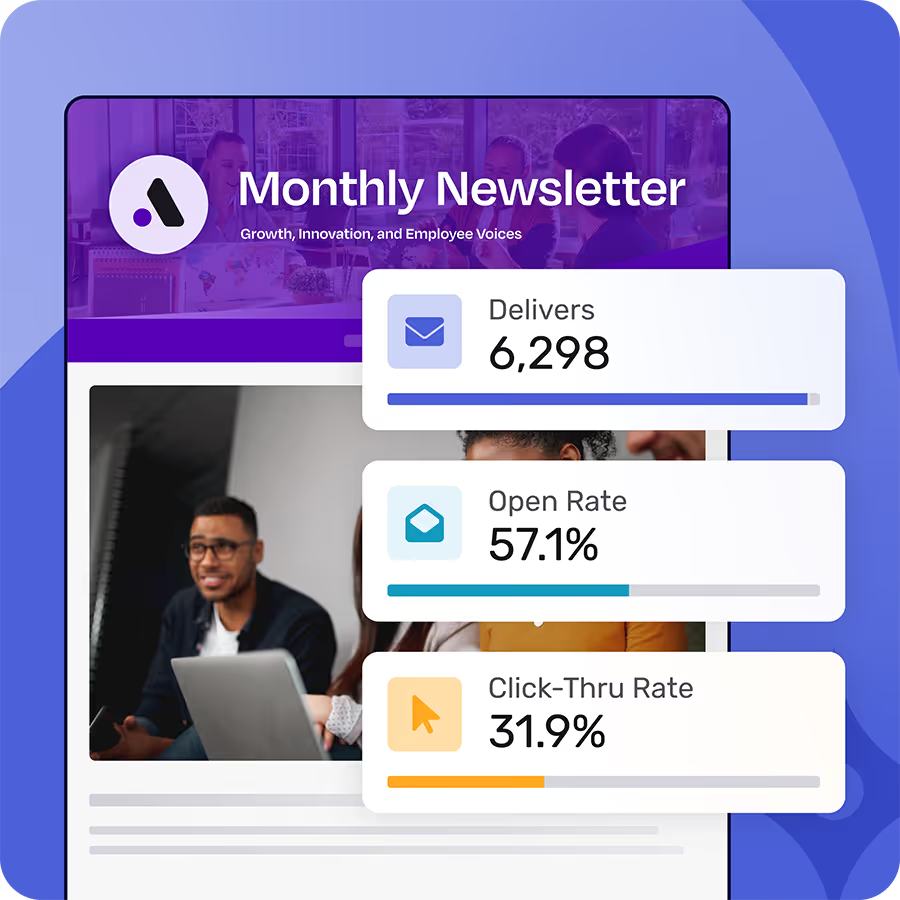
Foundations shows who opened, clicked, and engaged with your employee communications so you know what’s actually working. All for free - forever.
How do you build an internal comms measurement baseline from 2026?
Review a handful of 2026's priority messages. For each one, record who it reached and who read it, group by group, and the gaps will tell you what the 2027 plan has to fix.
Gallagher's State of the Sector report makes the case for measuring against your own history. Vinny Foreman, a strategy partner in Gallagher's Behavior and Insights practice, was blunt about it in the report, writing that "when it comes to measurement, forget benchmarking -- baselining is the way forward." No two organizations are alike in culture or deskless population, he argues, so the useful comparison is progress against your own prior performance. A read baseline takes an afternoon.
Pick 5 to 10 priority messages from 2026. Choose the ones that had to land, such as benefits enrollment, policy changes, a reorganization and the leadership updates people were expected to act on.
Check reach. Write down which groups each message went to and which groups it should have reached. Missing lists and stale audiences show up here fast.
Check reading per group. Use opens and clicks as signals and acknowledgments as confirmation. Silence is data too.
Mark the gaps by group. Look at locations, shifts, frontline staff, new hires and managers separately.
Note what each gap cost. A missed enrollment deadline or a week of questions landing in HR's inbox belongs in the budget conversation.
Step four matters more than it looks. Gallup's State of the Global Workplace 2026 report found that 30% of exclusively remote employees are engaged, compared with 17% of on-site employees who can't work remotely. Gallup measured engagement, so treat it as a pointer. If engagement varies that much by where people work, reading probably varies too, and a company-wide average will hide the night shift.
Put the results in one table you can copy into a doc or spreadsheet.
Priority message
Intended audience
Reached
Read (signal or confirmed)
Gaps by group
What it cost
Benefits enrollment reminder
All benefits-eligible staff
Updated remote work policy
All staff
Q3 leadership update
All staff
A full internal communications audit reviews channels, content, perception and tools across the function. The baseline asks a narrower question about whether the messages that mattered reached their people, and it can feed an audit later.
What if your 2026 data is incomplete?
Use what you have, from send logs and open data to a rough count of questions HR fielded after a big announcement. Mark what you can't see as unknown. An honest "we don't know whether the night shift read this" is a finding in itself, and capturing a real baseline in Q1 becomes one of your 2027 goals.
How do you set 2027 goals against the baseline?
Set read and reach targets per audience and per priority message, starting from the 2026 number. A goal that names a group and its starting point is one you can report on in December 2027.
With X and Y standing in for figures from your own table, one goal might read "Benefits enrollment reminder confirmed read by X% of each site, up from Y in 2026." Another might read "Policy updates reach everyone in the intended audience on the first send, with no site below X% confirmed reads." If your baseline shows one location reading at half the rate of the rest, the goal names that location.
Write one goal per gap the baseline found. Four sharp goals tied to real gaps are easier to defend than twelve. These SMART goal examples for communication show how to make each one measurable and time-bound.
Which channels and calendar moments belong in the 2027 plan?
Keep or add channels where the baseline shows each group reads, and build the calendar around your priority moments.
If office staff read email reliably, email stays their main channel. If shift-based staff barely touch it, reach them through a manager briefing or a screen by the time clock, and keep email as the record. Managers deserve their own line in the plan. They often reach the groups email misses, and they need the message before their teams do.
The calendar follows the same logic. Start with the 2027 moments that carry real consequences, such as open enrollment and planned system changes, and plan backward from each one, from the manager briefing to the follow-up with groups that didn't read. Our guide to running an internal communications content calendar covers the mechanics, and our internal communication plan template gives you the structure for the plan document itself.
How do you use the baseline to justify the 2027 internal comms budget?
Show leadership where the 2026 gaps cost the business and what closing them takes. The case fits on one slide.
What landed. The priority messages each group confirmed.
The gaps and their cost. Pull these from the last column of your table, such as the policy update that needed three sends.
The ask. Tie each item to a specific gap, such as a tool to confirm reads on must-read messages or time for manager briefings.
The internal communications plan 2027 budget case on one slide: what landed, the gaps and their cost, then the ask.
Start capturing it now, so the baseline exists by the time your 2027 plan is reviewed.
Cerkl Broadcast Foundations is a free-forever way to start, with no credit card or contract. It includes 5,000 email sends a month and 3 communicator seats. Insights shows opens and clicks for each send and for each employee from your first blast, so you can compare groups from day one. Acknowledgments add timestamped read receipts for must-read messages. If you outgrow the limits, upgrading lifts them on the same account and your send history carries over.
Pick your next priority message and send it where you can see who read it. You'll have the first row of next year's evidence before the plan is approved.
If you're frustrated with Outlook or Gmail for your employee emails, we understand.
That's why we built Foundations. Purpose-built for internal email with all the features you wish you had - drag-and-drop email builder, analytics, employee segmentation and much more. All for free (forever). No credit card, no contracts, no setup fees.
What should a 2027 internal communications plan include?
A 2027 internal communications plan should start with a read baseline from 2026, then set goals per audience and per priority message, choose channels by where each group reads, plan a calendar around priority moments, and tie any budget ask to closing the specific gaps the baseline found.
How do you set an internal comms measurement baseline?
Pick five to ten of 2026's priority messages. For each, record which groups it reached and who read it, using opens and clicks as signals and acknowledgments as confirmation. Mark the gaps by group, such as location or shift, and note what each gap cost the business.
How do you justify the internal comms budget for 2027?
Use the baseline. Show leadership which 2026 gaps cost the business, such as missed deadlines or repeat sends, and tie each part of the ask to closing a specific gap. Leadership funds visible problems more readily than general requests for more investment.
Are open rates a reliable way to measure internal email?
Not on their own. Apple Mail Privacy Protection can load images when a message arrives, before anyone reads it, and security tools in many Microsoft 365 workplaces scan links before delivery. Treat opens and clicks as signals per group, and use acknowledgments to confirm reads on must-read messages.
What if I don't have 2026 read data?
Start capturing it now so a baseline exists before your plan is reviewed. Cerkl Broadcast Foundations is free forever, with 5,000 email sends a month and 3 communicator seats. Insights shows opens and clicks per send and per employee from the first blast, and acknowledgments confirm reads on critical messages.
Did you enjoy this content? Please share it with your internal comms friends and colleagues. Just click on any of the links below.