AI Newsletter for Employees: Where It Needs a Human, and How to Set It
AI newsletter for employees: what AI does well, where a human still decides, and how to set one up so each employee gets the stories that matter to them.



AI newsletter for employees: what AI does well, where a human still decides, and how to set one up so each employee gets the stories that matter to them.
An AI newsletter for employees uses AI to build and send internal news, so each employee gets the stories that matter for their role and interests. AI writing tools can also speed up drafts and summaries. People still own accuracy and priorities, and read data shows who read it.
If your monthly update takes the comms team days to write and then another round of days to re-cut for operations, sales, the plants and the regional offices, you already know where the hours go. AI can take most of that build off your plate. It can't decide what every employee must see, and it can't make anyone open the thing, let alone read it. The sections below split the work between AI and your team, then walk through a setup that saves time without losing the messages that matter most.
The phrase covers two different tools that solve two different problems, and most of the confusion in vendor demos comes from blurring them. The first is generative. AI writing tools draft or summarize copy from your source material, so a long policy memo becomes a short newsletter item. The second is curation and personalization, where AI selects and orders stories for each employee from a shared pool of content, so 5,000 employees can receive 5,000 different newsletters without anyone building 5,000 versions. That second kind is what most people mean by a personalized employee newsletter.
Most teams want both, but they are separate tools and separate decisions. When the complaint is "it takes us days to personalize this for every department," the bigger time sink is almost always the curation job. Cerkl's AI Newsletters, also called News Digest and included in the Omni AI plan, are the curation kind, assembling a different newsletter for each employee and sending it automatically. If you're weighing AI across email, chat, intranet and everything else at once, settle the broader question of where AI belongs in your communications stack first, because this post stays on one channel.
If you're working out how to use AI for an employee newsletter, start with the jobs it does well, because those are the ones worth automating first.
AI writing tools are good at turning a long source document into something a busy employee will scan. Give a general AI assistant the notes from a benefits briefing and it will return a passable first draft or a three-line summary in seconds. This works best for informational, routine content. A University of Florida summary of research on AI-assisted workplace writing found that AI may be appropriate and professionally received for routine communications like meeting reminders or factual announcements. A human still edits every draft before it goes anywhere, because the draft is only a starting point.
Subject lines are where many newsletters lose their audience before the first story. AI can generate a subject line per reader based on what's in that person's edition, such as the top story or the categories they follow, and fall back to a single default line for employees the system knows little about yet. That fallback matters more than it sounds, because new hires and people who never set preferences still need a subject line that makes sense.
This is the heavy lift that AI takes off the team. A comms manager used to decide which twelve stories go to the warehouse and which go to finance. Now the system ranks stories for each person by role, stated interests, past engagement and the content they've already seen. One content pool goes in, and a different newsletter comes out for every employee. The department re-cut that used to eat two days becomes a set of rules you configure once.
Global and frontline-heavy organizations rarely have one shared language, and translating every edition by hand doesn't scale. Auto-translation lets each employee read the newsletter in the language they chose, from the same source story. Have a fluent reader spot-check must-read items in your largest languages, since machine translation can miss the nuance in a policy change.
The weekly send is a build-and-launch ritual for most teams. With an AI newsletter, employees choose their own day, time, frequency and format, and the send runs without anyone assembling an edition. Add it up and your team gets back the hours it spent on the weekly build and the department versions.
The working model is simple to state. The human sets the rules, and AI applies them per person. Four areas stay with the comms team no matter how good the tools get.
Generative AI can be wrong with total confidence. NIST's Generative AI Profile of the AI Risk Management Framework describes this as confabulation, the production of confidently stated but false content by which users may be misled. In an employee newsletter, a wrong enrollment deadline or a misquoted policy does real damage, so every AI-drafted line gets a fact check before send. Curated stories are a different case, since they are only as accurate as what your team already published, which puts the accuracy burden back on the content source. Our piece on AI hallucinations in internal communications covers the full set of failure modes and the checks before and after send.
Personalization shows people what they're likely to care about, and that is exactly the wrong logic for a safety notice or a policy change everyone must acknowledge. Leadership and the comms team decide what everyone sees. Any AI newsletter you run needs a way for must-read content to override the algorithm and the employee's own topic exclusions, so the most personalized edition still carries the story every employee needs.
The research on how employees perceive AI-assisted writing at work covers messages from managers, and it points in a clear direction. In the study of 1,100 working professionals behind the University of Florida summary, only 40% to 52% of employees viewed supervisors as sincere when a congratulatory message used high levels of AI assistance, compared with 83% for low-assistance messages. The same researchers concluded that relationship-oriented messages, such as praise, congratulations, motivation and feedback, are better handled with minimal AI. By analogy, the newsletter items that carry the most emotional weight, such as layoff news or a recognition story, should stay human-written. We've written about why AI can't make them believe it, and a newsletter follows the same rule.

Decide up front who approves AI-drafted content and when you'll tell employees that AI was involved. Senior communicators interviewed for research by Linjuan Rita Men and colleagues, as reported by HR Reporter, described a widely adopted consensus that co-piloting, with the human leading, is the best approach. On disclosure, the same researchers' view was that context matters, which argues for writing a policy before the first case comes up.
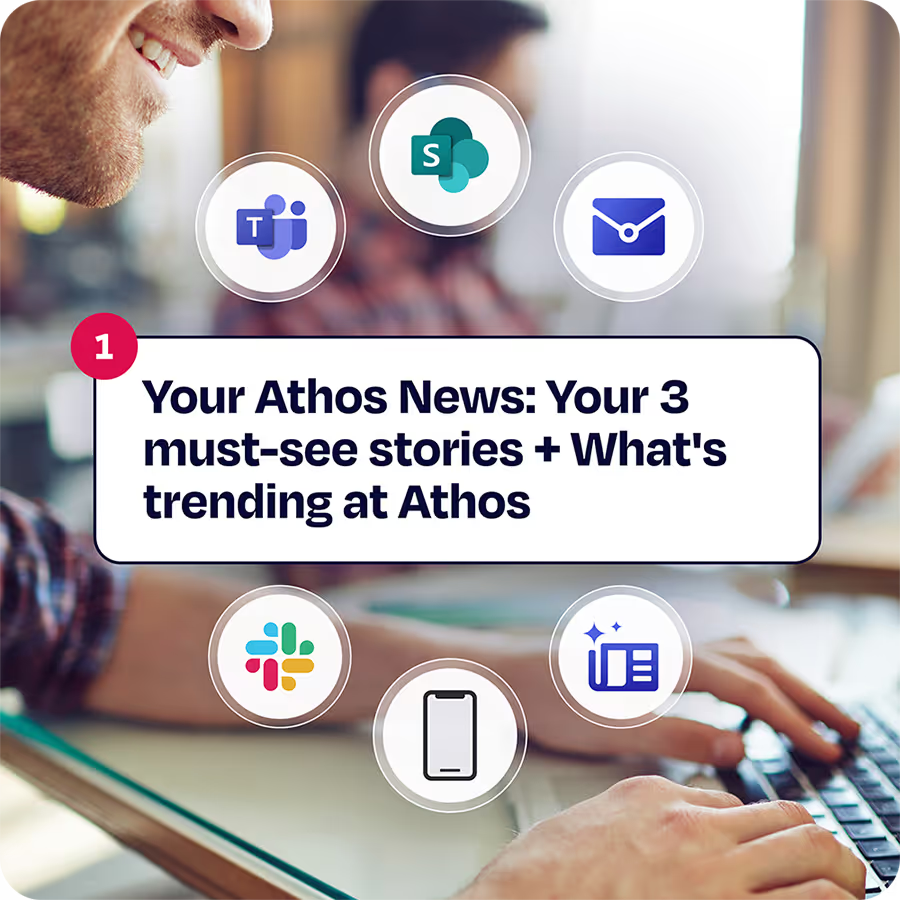
Broadcast Omni AI lets you deliver personalized messages across email, mobile, Teams, intranet, and more while keeping audiences and messaging aligned.
Learn more about Omni AIThe AI features that matter most in employee newsletter software map to the steps below. Work through them in order, because each one depends on the one before it.
AI can only curate what it can reach. If stories live in leaders' inboxes and a dozen SharePoint folders, the newsletter will be thin no matter how smart the ranking is. Set up one feed that holds stories and events, tagged by category, with an owner for each content stream. This is also the moment to agree on what counts as a story, so the pool doesn't fill with near-duplicates that the algorithm then has to sort through.
Personalization starts from real employee attributes. Pull role and location straight from your HRIS, and let those segments refresh automatically as people join and change jobs. A spreadsheet someone last updated in spring won't keep up. Stale lists are the quiet failure of most personalized newsletters, because the AI makes perfect choices for a person who changed roles six months ago.
Write down the rules for content that overrides personalization, then configure them before the first send. Typical cases are compliance items and anything with a deadline. In Cerkl, communicators set a posting priority of "To Everyone" or "To Everyone as First Story," and those stories reach every subscriber regardless of an employee's interests or topic exclusions.
The first send should ask employees to personalize their newsletter. A welcome prompt where people pick their topics, schedule, format and language gives the AI explicit signals before any behavior data builds up. Cerkl's Welcome Email sends automatically to each new opted-in subscriber and prompts this setup, including a choice of 133 languages for auto-translation.
Decide how much of each subject line the system generates and which fields, such as the employee's name and their top story, it can pull in. Then write one fallback line for employees with no preference data yet, and test that it reads naturally on its own. Cerkl's subject-line generator has three modes, from fully automatic Classic to a single static Custom line, plus a Fallback Subject Line for subscribers the system can't yet personalize for.
Before launch, look at what a frontline employee and a new hire would each receive. Check that must-read items land where you expect and that no segment gets a thin edition with nothing relevant to it. In Cerkl, the News Digest Simulator shows any subscriber's next subject line and ordered stories, so you can run this check by name. The employee newsletter best practices you already follow, such as scannable headlines and one clear action per item, still apply when AI does the assembly.
The last step is measurement, and it deserves its own section because it's the one AI handles worst on its own.
No, and this is where AI newsletter claims tend to get ahead of themselves. Sends and opens both fall short of proof that anyone read. Apple's documentation on Mail Privacy Protection explains that its Mail app downloads remote content in the background by default, regardless of whether the recipient engages with the email. Open tracking depends on that remote content loading, so an open count tells you only that something loaded, and adding AI to the assembly doesn't change that.
Per-employee data that goes past opens closes the gap. Look at who clicked and who confirmed an important item with an acknowledgment, then break that down by segment so you can see which plants or regions went quiet. Cerkl's communication analytics show opens and clicks per employee with segment filters, which turns "the newsletter went out" into a follow-up list for the people who need the message through another channel. AI can build the newsletter, but as we've argued before, it can't make them read it, and only read data shows you whether it worked.
The model that holds up is a division of labor. The comms team sets the rules on accuracy and priorities, and AI applies them per person. Read data then tells you whether any of it reached anyone. If department-by-department personalization is where your team's days go, start by looking at how AI Newsletters assemble and send a different edition for every employee.
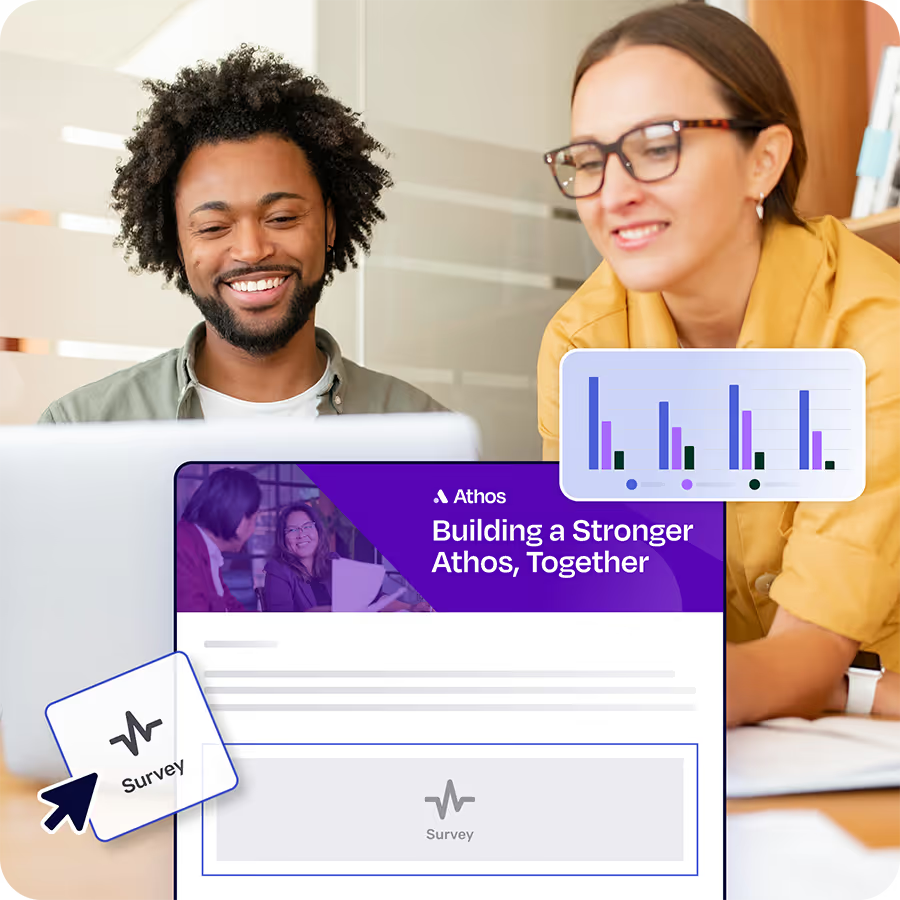
That's why we built Foundations. Purpose-built for internal email with all the features you wish you had - drag-and-drop email builder, analytics, employee segmentation and much more. All for free (forever). No credit card, no contracts, no setup fees.
Learn more about FoundationsCan AI write our employee newsletter for us?
AI writing tools can draft items and summarize long source material, and they work best on informational, routine content. A human still needs to fact-check every draft before send, because generative AI can state false things confidently, and relational content such as recognition and leadership notes should stay human-written.
Is an AI-personalized newsletter different for every employee?
Yes, for the curation kind. Every employee draws from the same content pool, but the selection and order of stories differ by each person's interests and past engagement. Must-read items set by the comms team still reach everyone, regardless of personalization.
Should we tell employees the newsletter is AI-generated?
Context matters. Be open that the newsletter is personalized and how employees can change their preferences. Research on AI-assisted messages from managers found that heavy AI use lowered perceived sincerity, so keep relational content human-written and set a disclosure policy for anything AI drafted.
Does an AI newsletter for employees work for frontline and deskless workers?
Only if it reaches them. Frontline and deskless employees need a delivery address or channel they check every shift, plus language and schedule choices that fit shift work. Personalization can't help an employee who never receives the newsletter.
How do we measure whether an AI newsletter works?
Track clicks and confirmations per employee and per segment over time, and treat a single open rate with caution. Email clients can record an open without anyone looking at the email, so clicks and acknowledgments are stronger signals. Segment trends show where to follow up.