<script type="application/ld+json">
{ "@context": "https://schema.org", "@type": "FAQPage", "mainEntity": [ { "@type": "Question", "name": "How do you announce a reorganization when details aren't final?", "acceptedAnswer": { "@type": "Answer", "text": "Announce it anyway. Say what is changing, who it affects, what is not yet decided, when people will hear more, and who to ask." } }, { "@type": "Question", "name": "Who should hear about a reorganization first?", "acceptedAnswer": { "@type": "Answer", "text": "Leaders hear first, then managers, then affected teams, then everyone, in the shortest window you can manage. Anyone whose own role is changing hears from a person, a manager or HR, before any broadcast." } }, { "@type": "Question", "name": "What should managers say when they don't have the answer?", "acceptedAnswer": { "@type": "Answer", "text": "They should say so and give a date for the next update. 'I don't know yet, and I'll tell you by Friday' beats a guess." } }, { "@type": "Question", "name": "How do you communicate a restructuring to teams that aren't affected?", "acceptedAnswer": { "@type": "Answer", "text": "Send a short note on what isn't changing for them and what they may notice, with a date for the next update. Don't promise more than you know, since a reorganization can have later rounds." } }, { "@type": "Question", "name": "How do you know employees have seen a reorganization announcement?", "acceptedAnswer": { "@type": "Answer", "text": "Only an acknowledgment confirms that a person saw it and responded. Opens and clicks are signals, since email privacy features and security scanners can trigger them without the employee. Send each group its own message so each group has its own report." } } ]
}
</script>
How to Communicate a Reorganization Before the All-Hands
How to Communicate a Reorganization Before the All-Hands
How to communicate a reorganization between the memo and the all-hands: who hears first, what to say, sample messages, and how to close the gaps in time.
Written By:
Cerkl Research Team
Published:
November 23, 2026
Using Outlook or Gmail for your internal communication?
Foundations is free (forever) - purpose built for internal comms and includes everything you need to level up your game (email builder, analytics, pulse surveys and much more).
To communicate a reorganization, brief leaders first, then managers, then affected teams, then everyone, in the shortest window you can. Say what is changing, who it affects, what is undecided, when people will hear more, and who to ask. Then confirm which groups have the update before the all-hands.
Most advice on how to communicate a reorganization covers the announcement and the all-hands. The confusion starts between them, when some people have the memo and others have a rumor or a manager who knows no more than they do. This guide is for whoever got handed that stretch of time, with or without a comms team, and it includes short samples to copy.
Why Is Communicating Change in a Restructuring So Uneven?
General change comms assumes one message can travel to one audience, and communicating change in a restructuring breaks that assumption. Information arrives in pieces and people are affected unequally. The managers you are counting on to explain it may be affected themselves.
The closest survey data covers layoffs, a harder case than most reorganizations, so read it as a warning about the gap. Careerminds, an outplacement vendor, surveyed more than 1,000 full-time U.S. workers who were laid off or saw a team layoff in the prior 12 months. The most common way laid-off respondents learned about potential cuts was rumor or informal conversation, at 34%, while 27% first heard from their manager or HR.
People also start from a low baseline. In a 2025 Gartner survey of more than 2,850 employees, reported by IT-Online, 79% of employees had low trust in change, so assume that doubt is in the room before you send anything.
In What Order Should People Hear About a Reorganization?
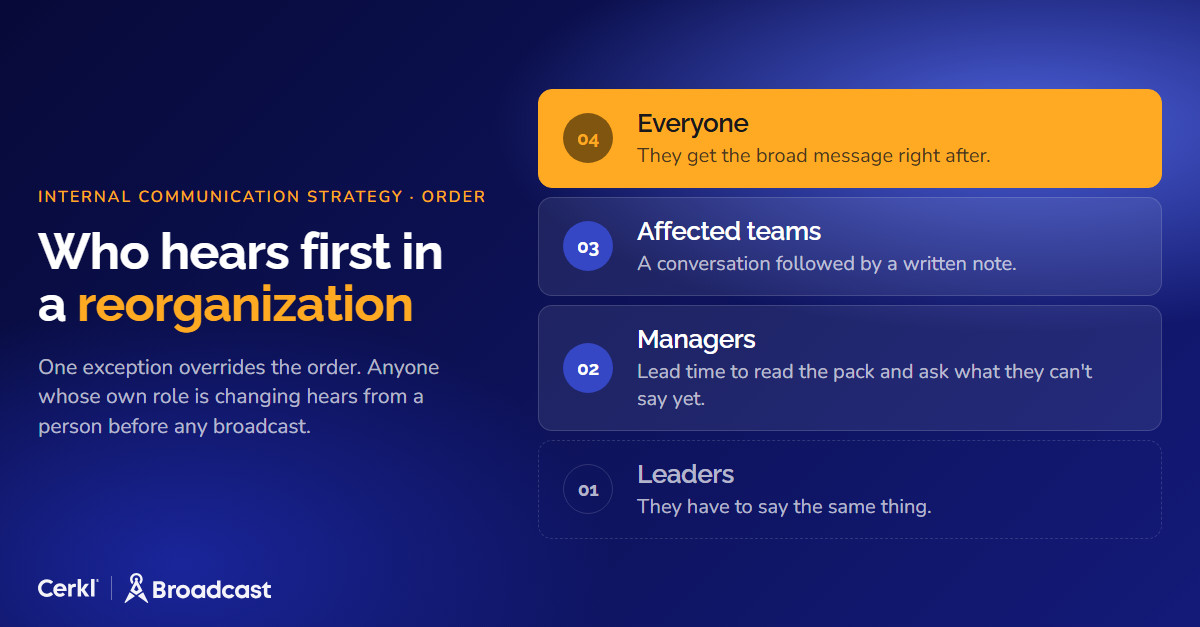
Leaders hear first because they have to say the same thing, and a leader improvising in a hallway is how two versions of the story start. Managers come next, with enough lead time to read the pack and ask what they can't say yet. That means hours, sometimes a day, because each person who knows is a possible leak. Affected teams hear next, in a conversation followed by a written note, and everyone else gets the broad message right after.
One exception overrides the order. Anyone whose own role is changing hears from a person before any broadcast, and that includes managers, before their briefing.
Four-step order for how to communicate a reorganization: leaders, managers, affected teams, then everyone.
Plan on a leak as well. Have the first message written and approved before the sequence starts, so you can send it within the hour if word gets out. If a merger is driving your reorganization, the 10-step communications strategy for mergers and acquisitions covers what the deal adds to this sequence.
What Should a Reorganization Announcement to Employees Say First?
Send the first message even when the details are unfinished. Tell people what is changing, who it affects, what is not yet decided, when they will hear more, and who to ask. Use plain words and name what is undecided, because people are less likely to fill a gap you've named with rumor.
The line that matters most is the committed time for the next update. Choose a time you can keep, and send the update then, even if you've decided nothing new.
First Reorganization Announcement Sample
Subject: A change to how our customer teams are organized
Team,
Starting [date], [Company] will combine Customer Support and Customer Success into one Customer team, reporting to [Name]. This affects people on those two teams and the groups that work most closely with them.
We haven't yet decided how accounts will be divided. I'd rather tell you that now than have you guess.
You'll hear more from me by [date and time], and your manager will talk with your team before then. If you have a question today, bring it to [Name] at [email].
[Leader name]
How Do You Follow Up With Each Affected Group?
To communicate restructuring to employees well, answer the question an all-staff message can't, which is "what does this mean for me?" That limit is the case for audience management over all-staff sends. Directly affected teams and adjacent teams whose work or contacts will shift each need their own follow-up. Unaffected teams need one too, or they will guess.
Audience Manager in Cerkl Broadcast builds segments from employee data, so each group can get its own message. Check the HR data before you rely on them, because segments synced from it show the old structure until someone updates the HR system, and in a reorganization that update may land after your sends. If it hasn't caught up, upload a manual segment for this sequence.
Resist re-sending the same news to everyone. Gallagher's 2025 Employee Communications Report, with more than 2,000 respondents worldwide, found communication and HR leaders naming change fatigue (44%) among their most challenging barriers, and a repeat all-staff note adds to that load.
Team Restructure Announcement Sample for an Affected Team
Subject: What the new Customer team means for you
Hi team,
Starting [date], you'll report to [Name]. Your customers and your current projects stay the same for now.
We haven't settled how accounts will be divided. We'll have an answer or a new date for one by [date].
Bring questions to me or to [Name].
[Manager name]
Sample Note to Unaffected Teams
Subject: The customer team change and your team
Hi team,
You aren't changing teams or managers in this round. You may notice new contacts on the Customer team, and we'll share an updated list.
You'll hear more by [date]. Bring any questions to me or [Name].
[Manager name]
What Goes in a Manager Guide to Communicating a Reorganization?
Managers carry most of this, and some are affected themselves. Don't assume cascading communication works unaided, since the same Gallagher report found leaders naming poor people-manager communication (41%) among those barriers.
The manager pack holds the core message, what it means for this team, what is undecided, likely questions with answers, who to escalate to, and when the next update arrives. Write out the questions people will ask out loud, such as "who do I report to?" and "is my job safe?", and answer each with what you know.
Give managers explicit permission not to know. "I don't know yet, and I'll tell you by [date]" beats a guess, because people repeat a guess as fact by lunchtime. Say in the pack that you know some of them are affected too, and give them a place to bring their own questions first.
An acknowledgment fits here. The pack is a must-act message, so ask each manager to confirm they have it.
Sample Manager's Script
I want to walk you through the change that was announced today. Starting [date], our team moves under [Name]. Our work and our current projects stay the same for now.
Some of this isn't settled, including how accounts will be divided. I'll tell you what I know by [date], even if the answer is still "not decided."
What questions do you have? If I can't answer one, I'll write it down and take it to [Name] today.
Critical messages that you know they've seen...
Foundations includes acknowledgements for free - an easy way to track which employees have (and haven't) taken action. No more guessing.
How Do You Check Which Groups Have the Update Before the All-Hands?
Run the check with enough time left to act on it, which rules out the morning of the meeting. Insights can lag, so leave margin.
The simple setup in Cerkl Broadcast is to send each group its own Blast, so each group has its own report. For each Blast, Insights shows each employee's delivery status plus opens and clicks. Those are signals, and only an acknowledgment is a confirmation from the employee. Apple's Mail Privacy Protection page says Protect Mail Activity downloads remote content in the background by default, "regardless of whether you engage with the email," so some opens happen without a reader. Microsoft's Safe Links documentation says URLs are scanned prior to message delivery when that protection is on, so some link activity can come from a machine.
An acknowledgment asks the employee to confirm, and the report lists each name with a timestamp, blank if that person hasn't confirmed. The mechanics are in our explainer on how acknowledgments work, and acknowledgments are included in the free Foundations plan. Use them for manager packs and must-act updates, and leave them off any message about someone's own role.
Report group-level status upward, something like "manager pack confirmed by [X] of [Y]." Keep names for follow-up only, since per-person tracking can feel like surveillance during a reorganization. Our change communication plan template has the full document behind this sequence, ready to copy.
How Do You Close the Gaps Before the Meeting?
Follow up only with the people who haven't confirmed, since a second note to everyone penalizes those who already paid attention. In Cerkl Broadcast, a retarget can go to people who haven't confirmed the acknowledgment, as long as the original Blast included one, and anyone who confirms before it fires drops off the send. You can only retarget a Blast once, so send it late enough that people have had a fair chance to respond and early enough that a manager can still reach whoever remains.
Hand managers the remaining gaps for a direct conversation, especially shift or field teams without easy access to email. Someone who has ignored two emails about a reorganization may have a question they don't want to put in writing. Then put the questions you have heard at the top of the all-hands agenda.
What Changes When a Reorganization Includes Layoffs?
The sequence above still applies, and the rules get stricter because people's jobs are at stake.
Anyone whose own job is affected hears from a person, their manager or HR, before any broadcast goes out. Email follows as the record, with the details they will need to refer back to, and that message carries no acknowledgment request.
Have HR and legal review every message. This post isn't legal advice, so take questions about timing and required notices to your own counsel.
People who stay need their own message about what happened and what it means for their work. Tell them where to ask questions, and say in plain words that people are leaving and that it is hard. Skip phrases like "exciting new chapter," and don't spin the news into an opportunity.
Can You Run This Sequence on a Free Plan?
Often, yes. Foundations, the free plan of Cerkl Broadcast, covers segments, scheduled sends, acknowledgments, retargeting and Blast Insights.
The limits matter, and not every reorganization fits inside them. Foundations includes 5,000 sends a month and 3 seats, and several group sends plus follow-ups add up, so count recipients across every message before you commit. Without billing details on file, sends stop at the cap, so check that before the all-hands. With them on file, overages bill at $0.09 an email. Calendar invites for the all-hands are Foundations+ and above, and Teams, Slack, SharePoint and mobile publishing are Omni AI.
Whatever tool you use, start today. Write the first message, including the date of the next update, and list the groups who need something different from it.
If you're frustrated with Outlook or Gmail for your employee emails, we understand.
That's why we built Foundations. Purpose-built for internal email with all the features you wish you had - drag-and-drop email builder, analytics, employee segmentation and much more. All for free (forever). No credit card, no contracts, no setup fees.
How do you announce a reorganization when details aren't final?
Announce it anyway. Say what is changing, who it affects, what is not yet decided, when people will hear more, and who to ask.
Who should hear about a reorganization first?
Leaders hear first, then managers, then affected teams, then everyone, in the shortest window you can manage. Anyone whose own role is changing hears from a person, a manager or HR, before any broadcast.
What should managers say when they don't have the answer?
They should say so and give a date for the next update. 'I don't know yet, and I'll tell you by Friday' beats a guess.
How do you communicate a restructuring to teams that aren't affected?
Send a short note on what isn't changing for them and what they may notice, with a date for the next update. Don't promise more than you know, since a reorganization can have later rounds.
How do you know employees have seen a reorganization announcement?
Only an acknowledgment confirms that a person saw it and responded. Opens and clicks are signals, since email privacy features and security scanners can trigger them without the employee. Send each group its own message so each group has its own report.
Did you enjoy this content? Please share it with your internal comms friends and colleagues. Just click on any of the links below.